Before
- Certificate requests land in a shared inbox or web form: a client's email, a GC's contract page, a town's bid packet, or just “same as last time”.
- An account manager reads each one against the policies: limits, additional insured, waiver of subrogation, primary and non-contributory, notice, dates.
- Gaps are found late, sometimes after the certificate went out, and the questions back to the client are written one by one.
After
- Each request is lined up against the policies and endorsements on file, requirement by requirement.
- Gaps that need a carrier endorsement or a higher limit are flagged, and anything vague is marked needs a look. Your account managers make every call.
- The certificate fields and description wording come out ready to check, with a draft reply to the client that asks only what's missing. Nothing is issued or sent on its own.
Certificate request (pick a sample, edit it, or paste your own)
Sample requests:
This page reads text only. In a pilot, emailed PDFs and contract pages are read first, and anything that can't be read with confidence is shown as "needs a look" instead of being guessed.
Pick a sample request or paste your own.
Requirement check
Every row shows what the request asks for next to what the policy shows.Certificate fields, prepared
For review · not issuedYour account manager checks these and issues the certificate in your own system, as today.
Draft reply to the client
Draft · not sentTo: Subject:
Edit freely. In a real build it opens as a draft in your own mailbox; nothing goes out on its own.
Under the hood: fields read from each document (JSON)
How the check works
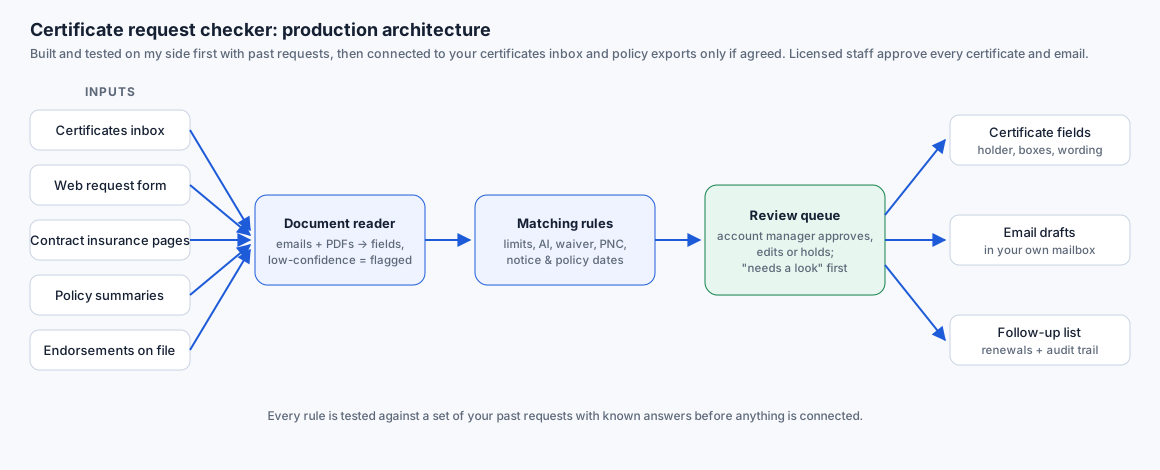
- Read. The request becomes structured fields: insured, certificate holder, project, due date, project end, and each requirement (limits, additional insured parties and operations, waiver, primary and non-contributory, notice, wording). This page uses a deterministic parser; a production build adds document reading for PDFs and contract pages and is held to the same field list.
- Match. Each requirement is checked against the policies and endorsements on file. Limits that are short on their own but could be met with the umbrella are marked for a person, not decided.
- Hold, don't guess. Missing endorsements, short limits, a different named insured, vague holders or parties, and notice periods longer than the policy gives are held. Your account manager decides.
- Prepare. The certificate fields and description-of-operations wording are drafted from what matched, and the reply to the client asks only about what's missing. Renewals that fall mid-project go on a follow-up list.
Production architecture